
The Youth Sports Investment Trap Families Don’t See Coming
I watch my son practice in the backyard every evening. Rain or shine. His determination is right there in every movement, every drill, every repetition.He wants this.And I'm paying for it. Every...
I watch my son practice in the backyard every evening. Rain or shine. His determination is right there in every movement, every drill, every repetition.
He wants this.
And I’m paying for it. Every year, the costs climb. Club fees, travel tournaments, private coaching, equipment needing replacement as he grows. I’ve run the numbers dozens of times. I know what this costs my retirement. I know I’ll work longer than I planned.
But when I see the look in his eyes, the drive to get better, the willingness to put in the work day after day, I keep writing the checks.
I talk to other parents at tournaments. We stand on the sidelines while our kids compete, and we all know the truth. We’re caught in something we don’t want to let go of. A dream. A fantasy, maybe. We know the odds. We know what the financial advisors would say, what I tell my own clients every day.
But we’re in it.
The difference is, I’ve spent nearly 30 years sitting across from families, watching them make financial decisions about their futures. Some decisions protect what they’ve built. Others quietly destroy it.
And I know where this one lands.
The club sports conversation has become one of the most financially dangerous discussions I have, both as a planner and as a parent living it.
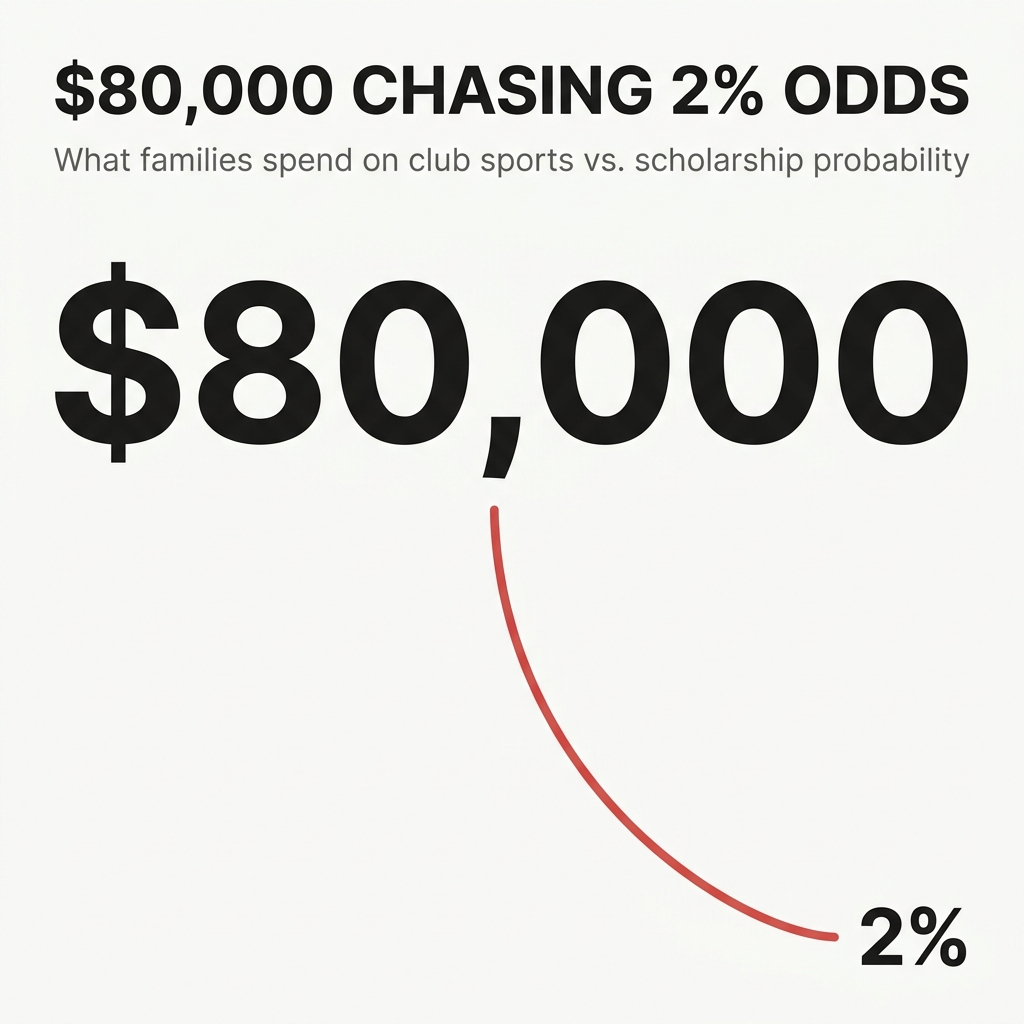
Not because sports are bad. Not because parents don’t love their kids. Because families are making $80,000 to $100,000 commitments without running the numbers, chasing outcomes with a 2% probability, and sacrificing retirement security for a scholarship mythology with no foundation in statistics.
The average sports family now spends $1,016 annually on their child’s primary sport, a 46% increase since 2019, twice the rate of inflation. But this figure includes recreational leagues and school sports. For families in competitive club and travel sports, the costs go much higher. When you account for additional sports, spending climbs to nearly $1,500 per child. Families in travel baseball alone spend $3,000 to $5,000 annually on travel and lodging. Some families report total costs reaching $25,000 per year.
Those are the advertised costs. The real number goes higher.
The Financial Clock Starts Earlier Than You Think
I’ve seen families commit to club sports when their kids are eight years old.
Eight.
This isn’t Saturday morning recreational soccer. This is year-round specialization, travel teams, private coaching, and the beginning of a decade-long expense trajectory growing annually as competition intensifies.
When I ask parents about their timeline, they focus on the current season. This year’s fees, next year’s equipment maybe. They’re not calculating what happens when you multiply $8,000 to $10,000 per year by ten years, with costs increasing 4 to 6% annually from inflation.
The math is brutal.
Start at age eight. Commit through high school graduation. You’re looking at $80,000 to $100,000 for one child in one sport. If you have multiple kids playing multiple sports, you double or triple the figure.
Most families don’t see this number until it’s too late.
The Hidden Costs Nobody Budgets For
When families come to me with club sports already in their budget, the first thing I point out is what they’re not seeing.
The advertised club fees are only the entry point.
Travel expenses destroy budgets. Weekend tournaments across state lines mean hotel rooms, gas, meals on the road. Travel baseball families spend between $3,000 and $5,000 annually on travel and lodging alone. One mother in Florida reports spending at least $8,000 per year on baseball for her 12-year-old son: $3,000 in club fees, $500 for a bat, $60 weekly for private coaching.
Equipment replacement cycles add up fast. Bats break. Cleats wear out. Uniforms change. You’re not buying once. You’re buying repeatedly as kids grow and gear deteriorates.
Specialized training becomes expected. Private coaching sessions, speed training, position-specific camps, massage therapy for young athletes playing year-round. These weren’t line items 20 years ago. Now they’re standard.
Injury costs are the wildcard. An estimated 12 million youth athletes between ages 5 and 22 suffer sport-related injuries annually, leading to approximately $33 billion in healthcare costs. The average charge for a leg fracture is $4,700. An arm fracture runs $2,900. An ACL tear exceeds $25,000 for surgery alone.
Even with insurance, families face major out-of-pocket expenses. Most health plans carry deductibles between $2,700 and $4,500. Physical therapy, rehabilitation, ongoing care for overuse injuries don’t get fully covered. Nearly half of parents with employer-sponsored insurance report their child experiencing a major injury, with 71% saying it cost up to $2,000 out of pocket.
You’re not paying for your child to play. You’re paying for the possibility they’ll get hurt while playing.
The Scholarship Mythology vs. Statistical Reality
Here’s the conversation I have with families investing tens of thousands in club sports hoping for an athletic scholarship.
The numbers don’t work.
Only about 2% of high school athletes receive any form of athletic scholarship to compete in college. Of the 8 million high school athletes, fewer than 180,000 receive athletic scholarships annually.
At the Division I level, where families think the money is, only 57% of athletes receive any financial aid. Book scholarships, partial rides, everything included. Only 1% receive a full ride.
Put this in perspective.
Of the 37 million kids who participate in youth sports, less than 22% will play high school sports. Of the 8 million who play high school sports, less than 2% will play Division I collegiate sports or receive scholarship money. Less than 0.08% will go on to play professional sports.
You have a better chance of getting your child into an Ivy League school than securing a full Division I athletic scholarship.
When I show families these numbers and compare them to academic scholarship opportunities, the realization hits hard. You find more scholarship money through academics than athletics. Academic scholarships don’t disappear if your child breaks an arm. They don’t get canceled when your kid tears an ACL junior year.
Athletic scholarships are fragile. Any serious injury wipes them out entirely.
The Trade-Off Families Don’t Calculate
The real financial damage happens when club sports expenses compete directly with retirement contributions, 529 plans, and emergency reserves.
When I sit down with families spending $8,000 to $10,000 annually on club sports, I show them what the money does in a retirement account or college savings plan over ten years.
Some are overwhelmed once they see the numbers.
$10,000 per year invested in a 529 plan at a 7% average return over ten years becomes approximately $145,000. The same money in a Roth IRA grows tax-free for retirement. But when it goes to club fees, travel, hotels, and equipment, it’s gone. You’re not building wealth. You’re spending it on a 2% probability outcome.
Middle-class families face impossible choices. They don’t have room in the budget for both. Club sports expenses of $5,000 to $15,000 per child directly reduce retirement savings, college funds, and financial cushions for emergencies.
I’ve had to tell families they don’t have the money to continue with club sports without damaging their retirement security. Most listen. They don’t change much, though.
Parents today spend more money on their children than any generation before. They want their kids happy, competitive, successful. I get it. But they don’t see far enough out. They don’t look at what happens when they hit their 50s or 60s and retirement is right there.
When Reality Sets In
The consequences show up years later.
Families realize the true cost when their children reach college age and may or may not have excelled in their sport. They understand they have to work longer. Maybe take an extra job. Maybe see their lifestyle decline to meet their own personal retirement goals.
I’ve watched this pattern repeat.
Reality sets in when you spend years investing in club sports and your child doesn’t make it to the next level. They’re not starting. They’re a bench player. They don’t progress from freshman to junior varsity to varsity quickly enough.
At this point families have the tough conversation with their child about taking it down a notch. But by then, they’ve spent $50,000, $80,000, $100,000. The money is gone. The retirement account is smaller. The 529 plan is underfunded. The emergency reserve is thin.
Around 64% of parents feel the financial burden of youth sports. Nearly 20% go into debt to afford it. One parent described the costs as “like having an extra car payment.” Another admitted to having a credit card specifically for youth sports with a running balance.
An estimated 70% of young athletes stop organized sports by age 13, often from burnout. Families invest heavily during early years only to see children quit before high school. No scholarship. No Division I future. Debt and a smaller retirement account.
The Manufactured Urgency Bypassing Rational Analysis
The youth sports industry operates on fear-based marketing.
Start early or your child falls behind. Specialize now or they won’t be competitive. Join this club or they’ll miss their chance. Get private coaching or they won’t make the elite team.
This manufactured urgency bypasses rational financial analysis. Families commit to multi-year contracts before calculating total cost of ownership or injury risk exposure. They’re making emotional decisions about their child’s identity and future without running the numbers.
The clubs want to be competitive. I’ve seen situations where a family has two children who want to play the same sport. One child is exceptional. The other is average. The club wants the exceptional child, so they accept the average child into a level above their ability to secure both. It’s common. It’s also dishonest.
It should be about how well a child performs at their level. But often it’s not.
The Framework Families Need Before They Commit
If you’re considering club sports for your child, ask yourself this question first.
Have I met my own financial needs for retirement, healthcare, and emergency reserves before committing to this expense?
If the answer is no, you’re making a trade-off with consequences down the line.
Here’s what I recommend families do before signing up:
Calculate the full ten-year cost. Don’t look at this year’s fees only. Multiply annual costs by ten years, factor in 4 to 6% inflation increases, and include travel, equipment, private coaching, and potential injury expenses. Get the actual number.
Run the scholarship probability. Look at the statistics for your child’s sport. Understand 2% of high school athletes receive Division I scholarships and only 1% get full rides. Compare this to academic scholarships.
Compare the opportunity cost. Show yourself what the same money would become in a 529 plan or retirement account over the same period. Make the trade-off visible.
Get an honest assessment of your child’s potential. Talk to other parents who’ve had experience with the club. Talk to independent coaches who will give you a straight answer. Ask whether your child is starting or sitting on the bench. Watch how they perform against the stars on the team.
Prioritize academics first. A good academic record opens more doors and more scholarship opportunities than athletic performance for 98% of students. Here’s something most families miss: colleges look for students who excel in the classroom and play sports. It shows the kid handles pressure, juggles multiple commitments, works with teammates. They’re getting a student who contributes beyond test scores. Don’t let sports interfere with education, health, or family time.
Set a spending boundary before you start. Decide what you have room for without compromising retirement savings, college funds, or emergency reserves. Stick to the number even when the club pushes for more.
Sports have value for kids. Physical health, teamwork, discipline matter. But not at the cost of your family’s long-term financial security.
The Uncomfortable Truth About Youth Sports Spending
Most parents are willing to listen when I show them these numbers. But they don’t change much.
They want to do everything for their child. They don’t want to be the parent who says no when other families are saying yes. They don’t want their child to feel left out or miss an opportunity.
I get it.
But I also know what happens 15 years later when reality sets in and the retirement account is $200,000 smaller. When they work until 70 instead of 65. When their lifestyle has to decline because they spent their future on a 2% probability outcome.
The youth sports industry has become a $40 billion economy built on parental hope and manufactured urgency. Clubs recruit younger and younger kids, creating decade-long financial commitments families don’t calculate fully before signing up.
You love your child and make rational financial decisions at the same time.
You support their development without sacrificing your retirement security.
You say no to club sports and still be a good parent.
The question is whether you’re willing to face the numbers before you commit, or whether you’ll realize the cost years later when you’re out of time to recover.
If You’re Going to Do It Anyway, And Most of You Will
Here’s the truth I’ve learned sitting across from families and living this myself.
Most of you won’t stop. You’re going to keep paying for club sports despite everything I’ve laid out. You’ll find a way to make it work because at the end of the day, this is what parents do.
I know this because I’m doing it too.
So if you’re committed to this path, at least build some financial discipline into it. Make your kids part of the solution instead of passive recipients of your sacrifice.
My 14-year-old son refs games for younger leagues. He does odd jobs over the winter and summer: shoveling driveways, yard work, helping neighbors. He makes $2,000 to $3,000 a year. The money goes into a savings account for his post-secondary education. He’s learning his athletic development costs real money, and he’s putting skin in the game.
Another family I work with has their daughter coaching younger players at the same club where she trains. She earns $25 per hour for private lessons and small-group clinics. Over a year, she brings in around $3,500. Half goes toward her club fees. The other half goes into a Roth IRA her parents opened for her. She’s 16, and she has earned income going toward tax-free retirement growth.
These aren’t solutions removing the financial strain. But they teach kids commitment works both ways. If they want to play at this level, they help fund it. They see the cost. They understand the trade-offs. And they start building work ethic and financial literacy serving them long after they stop playing.
If you’re going to spend the money, and I know most of you will, at least structure it so your kids learn something beyond their sport.