
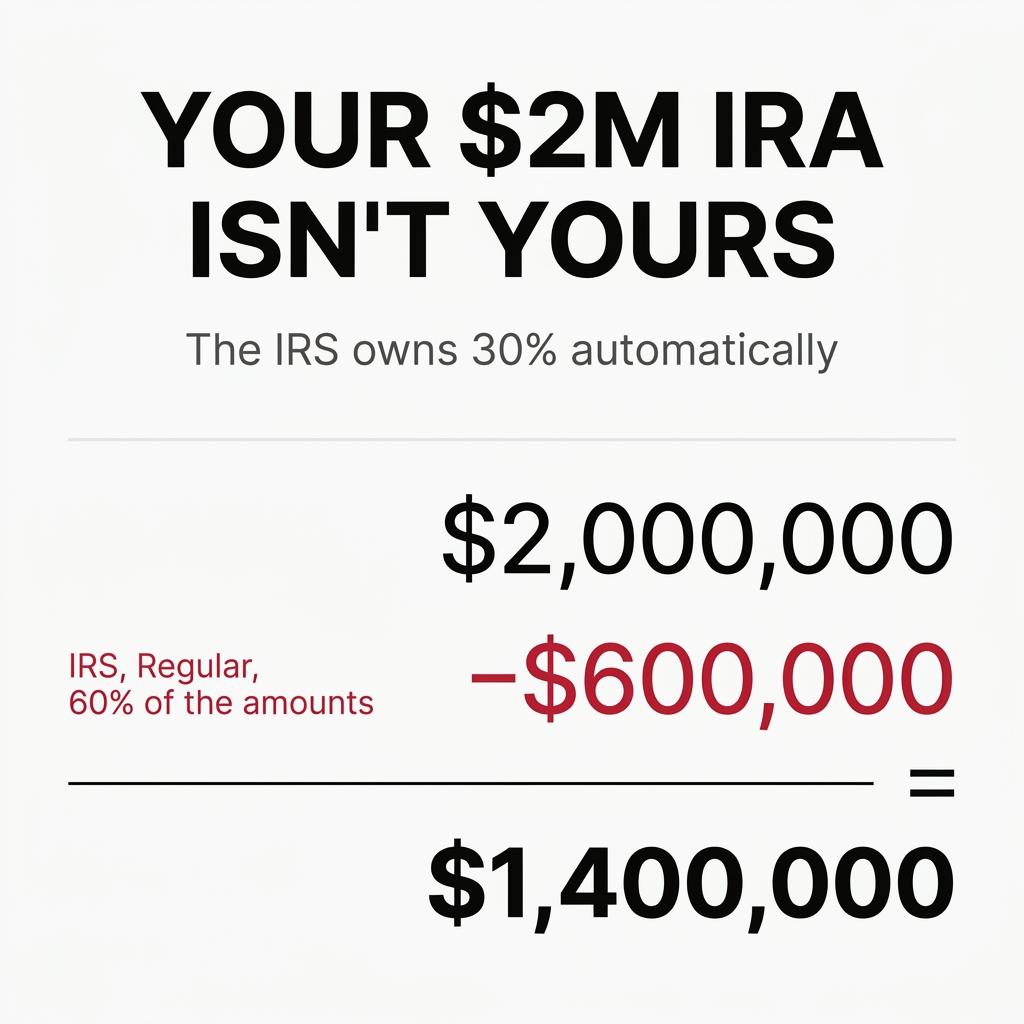
I've watched the same scenario play out for nearly three decades.Someone walks into my office proud of the $2 million IRA they built over 30 years of diligent saving. They did everything the...
I’ve watched the same scenario play out for nearly three decades.
Someone walks into my office proud of the $2 million IRA they built over 30 years of diligent saving. They did everything the conventional wisdom told them to do. Maxed out their 401(k) contributions. Took the tax deduction every single year. Watched their balance compound tax-deferred.
Then I show them what happens when required minimum distributions kick in at age 73.
That’s when they realize their IRA isn’t actually theirs. It’s a partnership with the IRS. And the IRS is about to collect decades of deferred taxes all at once, whether they need the income or not.
What most people call retirement success, I call being tax-deferred rich. You have substantial wealth on paper, but most of it sits in one tax bucket. When you start pulling money out to live on, you discover you’re not as wealthy as you thought.
The Tax Trap You Built While Doing Everything Right
Here’s what nobody tells you about traditional IRAs and 401(k)s.
The government lets you defer taxes on contributions because they know something you don’t. After decades of compounding, the government wants its cut. And they’ve structured the rules to make sure they get it.
Once you hit 73, required minimum distributions force you to withdraw a percentage of your account balance every year. Miss that withdrawal? You face a 25% penalty. Fix it within two years and the penalty drops to 10%. Either way, you’re paying.
But the real damage isn’t the penalty. It’s what those forced distributions do to your tax situation.
Higher income from RMDs triggers a cascade of tax consequences most people never see coming.
Your Medicare Part B and Part D premiums increase through Income-Related Monthly Adjustment Amounts. More of your Social Security becomes taxable. You get pushed into higher tax brackets. And here’s the part that catches people off guard: your 2026 RMD affects your 2028 Medicare premiums because IRMAA calculations look back two years.
You’re not just paying more tax on the distribution itself. You’re paying more for everything else because of the distribution.
Why Your Income Source Mix Matters More Than Your Withdrawal Rate
Most retirement planning focuses on one question: How much can I safely withdraw each year?
That’s the wrong question.
The right question is: Where does that income come from, and how do I coordinate multiple sources to minimize lifetime taxes?
I’ve seen clients with identical portfolio values and identical spending needs end up with wildly different tax outcomes. The difference? One pulled everything from their IRA. The other built an income architecture that layered multiple sources strategically.
When you pull $120,000 entirely from your IRA, you’re paying ordinary income tax on the full amount. Depending on your bracket, that could mean $25,000 to $35,000 goes straight to taxes.
But when you coordinate income from qualified dividends, municipal bonds, income annuities, and strategic IRA withdrawals, you control the tax outcome instead of letting required distributions control you.
The Qualified Dividend Advantage You’re Probably Underutilizing
Here’s a number that should get your attention.
Qualified dividends are taxed at 0%, 15%, or 20% depending on your income. Meanwhile, IRA distributions are taxed as ordinary income at rates that top out at 37%.
That difference isn’t small. It’s the gap between keeping 80% of your income and keeping 63%.
When you structure part of your portfolio for qualified dividend income in taxable accounts, you create breathing room around the IRA distributions you can’t avoid. You’re generating cash flow at preferential tax rates, which means you need to pull less from your IRA to meet your spending needs.
But most people do the opposite. They chase total return inside their IRA and ignore the tax treatment of income in their taxable accounts. That’s backwards.
Inside your IRA, you can invest in growth mutual funds that throw off capital gain distributions without immediate tax consequences. Those gains are only taxed when you withdraw money.
Outside your IRA, you want investments that generate qualified dividends and minimize capital gain distributions. Individual stocks, exchange-traded funds, and dividend-focused portfolios work well here.
Asset location matters as much as asset allocation. Where you hold investments determines how much tax you pay on the income they generate.
Municipal Bond Laddering for Tax-Free Income
Municipal bonds offer something rare in retirement planning: predictable income with zero federal tax liability.
If you buy bonds issued by your state of residence, you often avoid state and local taxes too. That makes a 3% municipal bond yield equivalent to more than 4.6% on a taxable bond if you’re in a 35% bracket.
But the real value of municipal bonds isn’t just the tax-free income. It’s how that income reduces your dependence on IRA withdrawals and keeps you below the thresholds where everything gets expensive.
Here’s how bond laddering actually works.
You build a ladder with short-term, intermediate-term, and long-term maturities. As short-term bonds mature, you reinvest the principal into longer-term bonds. Over time, your intermediate bonds become short-term, your long-term bonds become intermediate, and your new purchases become long-term.
This creates a steady stream of maturing bonds that generate predictable cash flow. You’re not dependent on market conditions or forced to sell at inopportune times. The bonds mature on schedule, return your principal, and provide tax-efficient income you can count on.
And here’s the part most people miss: while tax-free municipal bond interest doesn’t increase your modified adjusted gross income, interest from taxable bonds does. That means municipal bonds help you stay below IRMAA cliffs and avoid thousands in additional Medicare premium costs.
Municipal bonds have historically low default rates. You’re not taking on significant credit risk for this tax advantage. You’re simply structuring income in a way that keeps more money in your pocket instead of sending it to the IRS.
The Income Annuity Piece That Changes the Equation
Income annuities get a bad reputation because people misunderstand their purpose.
An income annuity isn’t about maximizing returns. It’s about creating a guaranteed income floor that takes market volatility off the table and gives you strategic flexibility with your other assets.
When you structure an annuity to cover your essential expenses, something shifts.
You stop worrying about what the market does month to month. You know your basic needs are covered regardless of whether we’re in a bull market or a three-year bear market. That psychological shift matters more than most financial models capture.
But there’s a tax advantage here too.
Income annuities have an inclusion ratio. Part of each payment represents return of principal, which isn’t taxed. Only the growth portion is taxable. This creates a partially tax-advantaged income stream that complements your other sources.
Here’s where people get it wrong: they look at annuities with guaranteed growth riders that require you to pay tax on the growth upfront. There’s no inclusion ratio with those products. You’re paying tax on money you haven’t received yet.
The annuities that work in this income architecture are the ones where you’re receiving a blend of principal and growth, and only paying tax on the growth portion. That lets you manage your overall tax liability more strategically.
The Critical Window Most People Miss Completely
There’s a period between retirement and age 70 when you delay Social Security that represents your best opportunity to defuse the IRA tax problem.
This is what I call the trough years.
You’re no longer earning employment income. Social Security hasn’t started yet. Your only income comes from pensions, investment distributions, and whatever you choose to pull from your accounts.
This is when Roth conversions make the most sense. You’re in a lower tax bracket than you were during your working years, and you’re in a lower bracket than you’ll be once RMDs kick in.
The strategy is simple: convert just enough from your traditional IRA to your Roth IRA each year to fill your current tax bracket without spilling into the next one. You pay tax on the conversion at today’s rates, and that money grows tax-free forever. You’ll never pay tax on it again, and it’s not subject to required minimum distributions.
But you need time for this to work.
The longer you can leave money inside the Roth after conversion, the more effective the strategy becomes. You need years of tax-free growth to overcome the initial tax cost of the conversion.
That’s why conversions done in your 50s and early 60s work better than conversions done in your late 60s and 70s. By the time you’re approaching RMD age, you’ve lost most of the compounding benefit. You’re paying tax now to avoid tax later, but there’s not enough “later” left to make the math work.
I’ve had clients come to me at 68 asking about Roth conversions. The window isn’t completely closed, but it’s closing fast. We’ve missed the optimal years when lower income and longer time horizons would have made conversions powerful.
The Coordination Strategy That Actually Works
Here’s what income architecture looks like in practice.
You need $120,000 a year to live on. Instead of pulling the full amount from your IRA and paying ordinary income tax on all of it, you layer multiple sources:
$30,000 from qualified dividends in your taxable account, taxed at preferential rates of 0-20% depending on your income.
$25,000 from municipal bond interest, completely tax-free at the federal level and potentially state level too.
$35,000 from an income annuity, with only the growth portion subject to tax because of the inclusion ratio.
$30,000 from strategic IRA withdrawals, keeping you in a lower bracket and below IRMAA thresholds.
Same $120,000 total. Dramatically different tax outcome.
The first scenario where you pull everything from your IRA might cost you $30,000 in federal taxes. The coordinated approach might cost you $12,000. That’s $18,000 more in your pocket every single year.
Over a 25-year retirement, that’s $450,000 in tax savings. And that doesn’t even account for the compounding effect of keeping that money invested instead of sending it to the IRS.
But coordination requires planning.
You need taxable accounts with the right investments generating qualified dividends. You need a municipal bond ladder producing predictable tax-free income. You need an income annuity structured with an inclusion ratio. And you need to manage IRA withdrawals strategically to fill lower brackets without triggering cascading tax consequences.
This doesn’t happen by accident. It happens because you planned for it years before you retired.
The First Five Years That Determine the Next Thirty
I can usually tell within the first five years of someone’s retirement whether they’re going to have a tax problem or a tax strategy.
The clients who build successful income architecture do a few things differently right from the start.
They shift contributions away from tax-deferred accounts in the years leading up to retirement. They’re not maxing out their 401(k) anymore. They’re building up taxable accounts and considering Roth contributions even though there’s no immediate tax benefit.
They execute Roth conversions during the trough years. They’re not waiting until RMDs force their hand. They’re converting strategically while they still have low-income years and time for tax-free growth to compound.
They structure their taxable accounts for tax efficiency. They’re not holding high-turnover mutual funds that throw off capital gains. They’re using individual stocks, ETFs, and dividend-focused strategies that generate qualified income.
They build municipal bond ladders that mature on schedule. They’re creating predictable tax-free income that reduces their dependence on IRA withdrawals and keeps them below critical tax thresholds.
They establish income annuities with inclusion ratios. They’re creating a guaranteed floor that covers essential expenses and takes market volatility out of the equation.
The clients who don’t do these things? They pull everything from their IRA because that’s where most of their money sits. They pay ordinary income tax on the full amount. They get pushed into higher brackets. Their Medicare premiums increase. More of their Social Security becomes taxable.
And once that pattern starts, it’s hard to reverse. You’re locked into a high-tax distribution strategy because you didn’t build the alternative income sources when you had the chance.
What Smart People Keep Getting Wrong
Here’s what I hear all the time: “I want to pay the lowest tax possible every year while my investments grow.”
I get it. Tax rates are historically low right now. Taking a deduction feels good. Watching your IRA balance grow tax-deferred is satisfying.
But that’s short-term thinking that creates long-term problems.
You’re optimizing for today’s tax bill without looking at your lifetime tax picture. You’re deferring taxes into a future where you might be in a higher bracket, where RMDs force income you don’t need, where that income triggers costs you didn’t anticipate.
The people who successfully minimize lifetime taxes think differently.
They’re willing to pay some tax now through Roth conversions to eliminate tax later. They’re building tax-free income sources even though it means giving up current deductions. They’re coordinating multiple income streams instead of taking the path of least resistance.
They understand that retirement income isn’t about withdrawal rates. It’s about architecture. It’s about building a structure where each income source activates at the optimal time to keep you below critical thresholds while meeting your spending needs.
That structure doesn’t build itself. You have to plan for it, execute it, and maintain it through annual reviews and analyzing past tax returns as your situation changes.
The Planning That Actually Matters
Cash flow planning isn’t something you do once and file away. It’s something you monitor and adjust continuously.
You need to know exactly how much income you’re generating from each source. You need to track how close you are to tax bracket thresholds and IRMAA cliffs. You need to adjust your withdrawal strategy based on market conditions, tax law changes, and shifts in your spending needs.
This is why I analyze past tax returns annually with clients. Not when they remember to call. Annually.
Because markets move. Tax laws change. Health situations shift. What worked last year might not work today. Static plans are theater. Dynamic plans are strategy.
The clients who succeed are the ones who treat this as an ongoing practice, not a one-time event.
They understand that building income architecture requires coordination between their financial advisor, their CPA, and their estate attorney. When these professionals work in silos, inefficiencies slip through the cracks. Nobody’s looking at the complete picture.
But when you integrate that advice, when everyone’s working from the same plan and communicating regularly, you catch opportunities and avoid problems that fragmented planning misses.
What This Means for You
If you’re sitting on a large traditional IRA and most of your wealth is in that one tax bucket, you have a problem you need to address now.
Not next year. Not when you’re closer to retirement. Now.
Because the strategies that defuse this tax problem require time to work. Roth conversions need years of tax-free growth to overcome the initial tax cost. Municipal bond ladders need time to mature and generate predictable income. Income annuities need time to establish guaranteed floors before you need them.
The longer you wait, the fewer options you have.
The question isn’t whether you’ll pay taxes in retirement. You will. The question is whether you’ll control how much you pay through strategic planning, or whether you’ll let required distributions and cascading tax consequences control you.
That choice gets made in the years before you retire, not after. It gets made through the income architecture you build, not the withdrawal rate you choose.
And it determines whether you keep 70% of what you’ve accumulated or 90%.
That difference is worth planning for.