
I am more concerned than I have been since 2008 for the future generations and retirees. There are quite a few disruptions in the economy that are not adding up.The world is becoming permanently...
I am more concerned than I have been since 2008 for the future generations and retirees. There are quite a few disruptions in the economy that are not adding up.
The world is becoming permanently unstable in ways that traditional retirement portfolio wasn’t built to handle.
The Strait of Hormuz scenario isn’t hypothetical. The 2026 crisis got described as the largest disruption to energy supply since the 1970s oil crises. Your retirement plan needs to survive.
The Problem With Traditional Diversification
Here’s what I’m seeing: clients come in with diversified portfolios—stocks, bonds, maybe some real estate or international exposure—and they think they’re protected.
But when supply chains get disrupted, when power dynamics shift between East and West, when land grabs and technology wars accelerate, that traditional portfolio structure doesn’t hold up the way it used to.
China has been quietly building economic and military strength while the U.S. focuses on maintaining supremacy. The question isn’t whether conflicts will happen. The question is how much longer the U.S. will accept not being number one, and what happens when that tension breaks.
You’re seeing it already. Russia trying to control Ukraine. China offering security and infrastructure deals globally while the U.S. pulls back from providing security to allies. This creates a West versus East dynamic that affects every investment decision you make.
Technology still matters. AI, robotics, quantum computing—these areas will continue growing. But the money being spent might outweigh profits for longer than companies can sustain. And the energy required to power data centers and produce this technology creates its own vulnerabilities.
You need exposure to technology, materials, industrials, agriculture, utilities, healthcare. But you also need to understand that political issues will cause corrections and volatility along the way.
When Bear Markets Stop Following Historical Patterns
We’ve seen severe bear markets before. The 2000 to 2002 crash. The 2007 to 2009 financial crisis. COVID.
Those all recovered with recognizable patterns. Most bear markets last under two to three years.
But what I’m describing now is different.
When you’re $39 trillion in debt and government spending on military technology keeps accelerating, when rare earth supply chains could get cut off, when the S trait of H ormu z or other trade routes get tied up—this could blow up in ways that don’t follow the historical playbook.
The spending may outweigh any profits. Companies might reset or realize less profit and get marginalized. Supply chain disruptions affect fertilizer, agriculture, food costs. Oil and gas prices spike. D is c re ti on a r y spending collapses because there’s not enough money left in Americans’ pocketbooks to buy unnecessary things.
Higher interest rates. Higher mortgage costs. In flat ion a r y pressures on food and energy.
The economy slows, and it might stay slow longer than the two-year cycles we’re used to.
The Rare Earth Problem Nobody’s Pricing In
Here’s something that hasn’t shown up in markets yet, but I think people are going to realize how significant this is to economic growth.
R a re earth elements. China controls them right now. And rare earth elements are needed for us to progress with technology.
If China decides to cut us off or restrict rare earth elements going into our chips, that could change the whole technology dynamic away from the U.S. and into Asia.
Supply chains are the concerning point. Any supply chain cuts haven’t fully shown up in our markets yet. But they will.
Yes, we could grow from this if diplomacy works and we do more of our own refinement—whether it’s energy, metals, or bringing industries back to the U.S. That could cut the recessionary period.
But people need to be retrained. That could take two, three, four years.
The market looks six to twelve months out. If we’re seeing changes happening with technology and production, it’s possible this is just a two-year bear market. Or it could last longer than three or four years.
Nobody has a crystal ball. But you need to prepare for the possibility that this isn’t a normal cycle.
What Happens When Your Client Needs $80,000 and Markets Drop 30%
Let me get tactical here.
You’ve got a 67-year-old client pulling $80,000 a year from their portfolio. Markets drop 30% because of a geopolitical crisis and stay down for three years.
Traditional advice says don’t sell, let it recover. But they need to eat.
This is where most retirement plans fail.
You need to look at retirement distribution differently. Look for guarantees. Set aside some money in annuities—immediate income annuities.
Yes, annuities have a bad name. I get it. They’re not cheap. They’re taxable. But so are pensions.
Years back, companies offered pensions. Then they shifted to contribution plans, which caused people to rely on themselves or their financial advisor for stability.
The more you’re into retirement and getting older, the more you need to be risk averse. Annuities are one of those risk averse ways of protecting your wealth and income during down times.
You also need two to three years worth of income set aside in short-term to intermediate fixed income where you can get yield. That gives you a cushion to get through a significant bear market without selling stocks at a loss.
We experienced this in 2007-2009. There was a bubble forming in the housing market before it burst. Similar things seem to be occurring now. The market might be in a bubble. The economy is overextended.
Markets have come back after tariff announcements and the beginning of conflicts with Iran. But they can certainly be prolonged and stay down if we have supply chain issues, higher costs of goods, and consumers saving more because uncertainty is greater.
The Sequence- of-Returns Trap
Here’s the math that destroys retirement plans.Back in 2007-2009, the S&P dropped 50%. It takes 100% gains to make back a 50% loss.
That takes time. But in the meantime, you’re still drawing money. Research shows that approximately 77% of a portfolio’s final retirement outcome can be explained by the returns of just the first 10 years. N eg a t i v e returns during the first five years account for 70% of retirement plan failures.
If you retire into a prolonged downturn driven by geopolitical instability, you’re withdrawing from a declining portfolio. That compounds the damage in ways that are almost impossible to recover from.
This is why you can’t just tell clients “stay the course” and hope for the best.
What Separates Proactive Advisors From Reactive Ones
At H a r b or W es t, we’re trying to be much more proactive than reactive. When you’re a retiree, you don’t have a lot of time to make up losses that occur in a long recessionary economy.
The biggest difference between what we did in 2008 versus today is setting aside two to three years worth of income needs in the investment portfolio. Always make sure you have that cushion. Look at industries that may be more opportunistic, but never compromise on having that safety buffer.
In c o me-type investments derived from consumer staples and real estate can provide the income you need as part of diversification.
The worst thing to do is get too emotional and sell when things are down. Then you’re losing, and it’s that much harder to make back what you lost.
Keep enough money set aside to get through a longer bear market. That’s the structural change I wish I’d made a decade ago.
The Conversation That Keeps Clients From Panicking
When headlines are screaming about the Strait of Hormuz being closed, oil hitting $150 a barrel, and your client’s account is down 35%, that two to three years of cash helps.
But they’re still watching their net worth drop.
Here’s the conversation I have: Don’t get too emotional. You still have growth in your investments, but you have enough money set aside to get through this and any future bear market.
We become more risk averse. We move the needle to make things much less volatile in your investments. The goal is making sure you don’t outlive your money.
We look at probabilities. What happens if the worst markets stack on top of each other? What’s your ratio or percentage rate of having a successful retirement in a prolonged bear market?
We make sure we meet your income needs and cover any hyperinflation that may be part of future concerns.
This isn’t about eliminating risk. It’s about structuring your portfolio so you can survive the risk without destroying your plan through panic decisions.
What a Successful Retirement Portfolio Looks Like in 2030
Five years from now, the dynamic will have changed.
China is growing. China has technology and infrastructure. They’re moving ahead at a faster pace than the United States in manufacturing, technology, autonomy, and robotics.
The usual allocation to China has been around 10%. That may change over time. If China applies a chokehold on rare earth elements, it’s going to make China grow that much faster.
We have to look at regions around the world and industries that have more stability than what we saw back in 2010. Foreign markets may have higher stability and be better places to invest.
But this isn’t about abandoning U.S. markets. It’s about recognizing that geopolitical instability is becoming permanent, and your portfolio needs to reflect that reality.
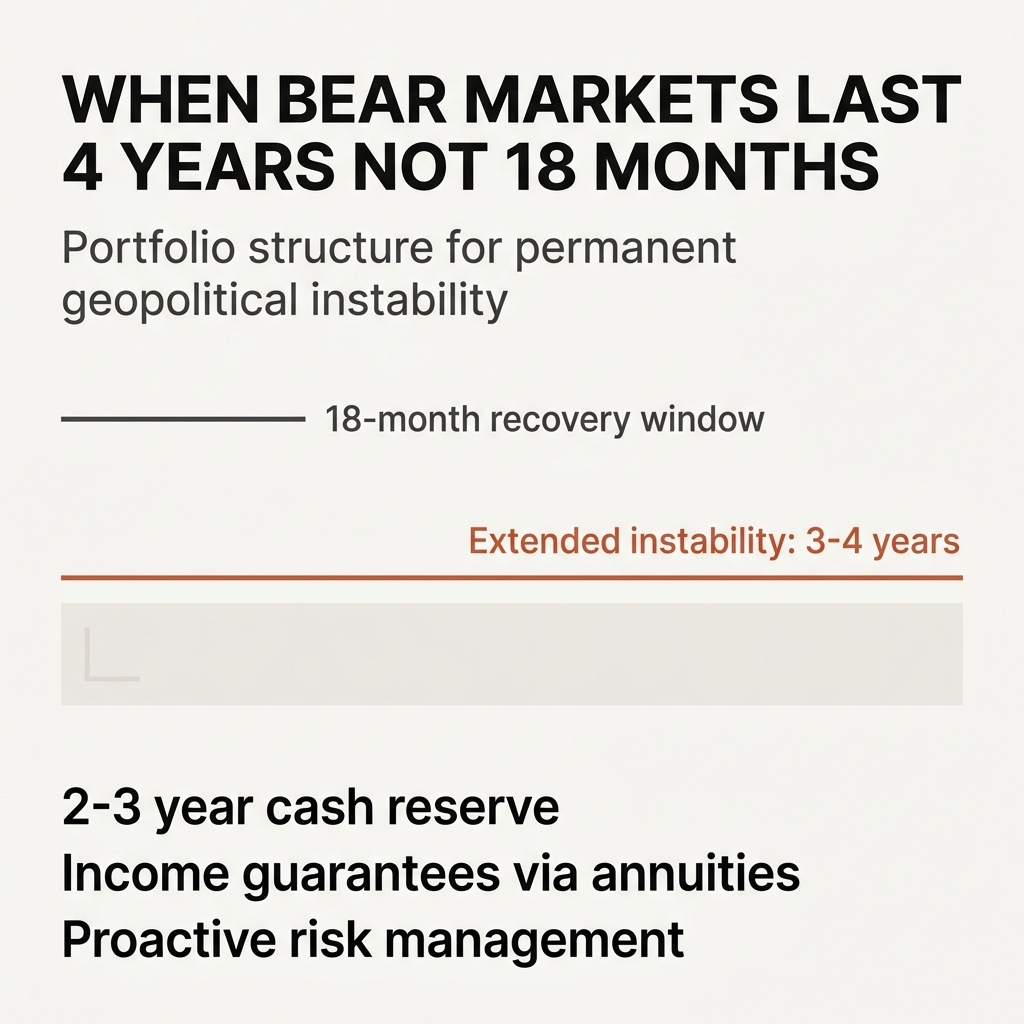
You need sector exposure that benefits from technology growth—materials, industrials, agriculture, utilities, healthcare. You need income guarantees through annuities. You need two to three years of cash reserves. You need to stress-test for scenarios where bear markets last three to four years instead of 18 months.
Most advisors are still building portfolios for a world that doesn’t exist anymore . They’re not preparing clients for prolonged geopolitical instability. They’re not building structural defenses against sequence-of-returns risk in a world where recovery patterns might not follow historical norms.
The clients who succeed in retirement over the next decade won’t be the ones with the highest returns. They’ll be the ones whose portfolios were built to survive what’s coming without forcing them to sell at the bottom or run out of money during extended downturns.
That’s the difference between a plan that works and one that fails when headlines start screaming.